
FamilyHero Blog
The Mental Load Is Breaking Co-Parents. Here's What Nobody Talks About.
Mothers carry 71% of the household mental load. After a divorce, it gets worse. School emails land in one parent's account. Doctor reminders go to whoever booked the appointment. Here's how to fix the information gap between two homes.
March 10, 2026
Here's the number that finally put a name to what co-parents have been feeling for years: mothers carry 71% of the household mental load across more than 30 recurring family tasks. That's not housework. That's the invisible cognitive labor of remembering, planning, and coordinating everything that keeps a family running.
Now multiply that by two households.
After a divorce, the mental load doesn't split evenly between homes. It gets worse. School emails land in one parent's account. Doctor reminders go to whoever booked the appointment. Permission slips, sports schedules, dental cleanings, picture day, early dismissals. All of it funnels through one parent while the other flies blind.
The result? 62% of parents have missed an important school event or detail because the information got buried. Not because they didn't care. Because the system failed them.
The Scale of the Problem
This isn't just about school emails, though those are bad enough.
Parents receive an average of 4 new school-related emails per day, adding up to more than 80 emails per month from schools alone. 52% of parents say they feel overwhelmed by their personal email. 71% say they feel like bad parents when they miss something important about their child.
But school is just one piece. Families spend an average of 8.5 hours per week coordinating schedules across all their commitments, and 56% of families have missed an important event due to scheduling conflicts. That's soccer practice conflicting with a dentist appointment, a school concert nobody put on the calendar, a well-child visit that got rescheduled and then forgotten.
And 83% of that scheduling responsibility falls on mothers.
That guilt hits different when you only have your kids 50% of the time.
The Hidden Cost: Missed Medical Care
Here's something co-parents rarely talk about, but it matters enormously. When family coordination breaks down, kids' health appointments are often the first casualty.
52% of parents rely on memory alone to track their children's medical appointments. No calendar entry, no reminder system, just hoping they'll remember. That's risky for any family. For families managing schedules across two homes, it's a recipe for missed visits.
The numbers bear this out. 30-50% of children miss recommended well-child visits, and over 1 in 4 children go without preventive dental care. These aren't optional checkups. They're where pediatricians catch developmental issues, where dentists spot cavities before they become emergencies.
The most frustrating part? 27-40% of all missed appointments are due to simple forgetfulness, not cost, not access, just nobody remembered. Across the U.S., missed appointments cost the healthcare system $150 billion annually.
When you're a co-parent, the question becomes: which household is tracking the six-month dental cleaning? Who remembers the annual physical? If the reminder email goes to Mom, does Dad even know it's happening during his custody week?
Why This Problem Is Worse for Co-Parents
In a married household, if one parent misses the email about the bake sale, the other one probably caught it. There's a built-in safety net: you share a fridge for the flyer, a dinner table for the conversation, a bed where one of you says "oh, did you see that thing from the school?"
After a divorce, that safety net disappears.
There are approximately 13.9 million custodial parents in the United States alone, and for most of them, school communications, medical reminders, and activity schedules flow to just one household. The other parent has to rely on:
Their ex remembering to forward every email
The school or doctor's office agreeing to add a second contact (some do, many don't)
Asking the kids what's going on (which works great until it doesn't)
This creates what family law professionals call information asymmetry. One parent knows everything. The other parent knows what they're told. And when the relationship is strained, that gap can become a source of real conflict.
It shouldn't be this hard to know about your own child's science fair or dentist appointment.
What Co-Parents Are Doing Today (And Why It Falls Short)
Most co-parents cobble together some combination of the following:
Manual forwarding. One parent screenshots or forwards school emails to the other. This works when both parents are communicating well and when neither parent is exhausted, distracted, or resentful about being the default information manager. In practice, things slip through. A lot of things.
Google Calendar sharing. Some parents share a Google Calendar and manually type in every event. This requires discipline from both parents and relies on someone actually reading the email, pulling out the date and time, and creating the calendar entry. That's three steps where a busy parent can drop the ball.
Dedicated co-parenting apps. Tools like OurFamilyWizard ($8-17/month per parent), TalkingParents, and AppClose offer shared calendars, messaging, and expense tracking. They're genuinely useful for communication documentation and keeping conversations civil.
But here's the gap every co-parent knows about: none of these apps automatically detect events from your email. Every single one requires you to manually enter calendar events. Which means someone still has to read all those emails, extract the important dates, and type them into yet another app.
You've moved the problem. You haven't solved it.
How FamilyHero Works for Co-Parents
FamilyHero takes a different approach. Instead of giving you another calendar to manually fill in, it connects to your email and automatically surfaces family-relevant events (school dates, activity schedules, medical appointment reminders) onto a shared family calendar.
Here's what that looks like for divorced parents:
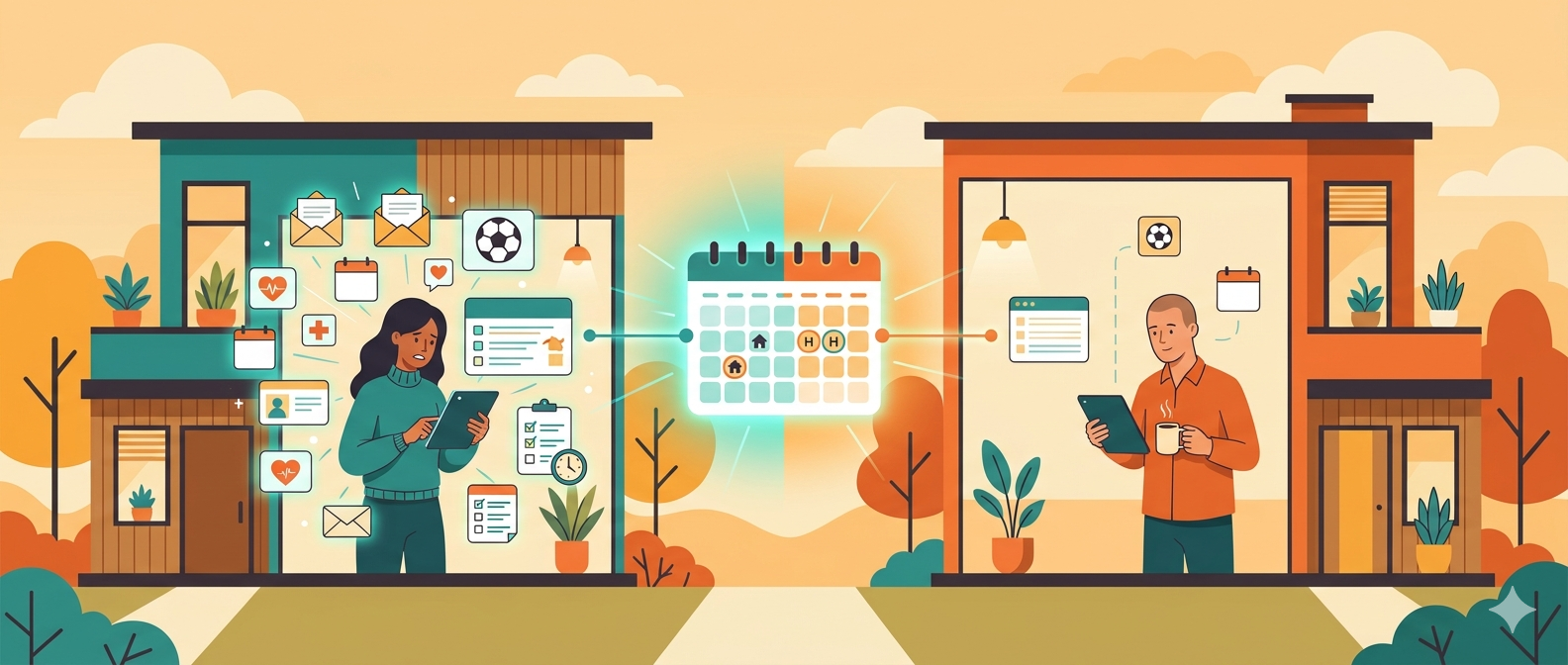
Each parent connects their own Gmail to FamilyHero. Mom connects hers. Dad connects his. If the school sends emails to Mom, FamilyHero detects the events in Mom's account. If Dad gets the dentist reminder, FamilyHero detects that too. Either way, the events show up on the shared calendar that both parents can see.
No forwarding. No manual data entry. No "I didn't know about it."
The school emails about picture day, the soccer league schedule, the dentist appointment reminder, the well-child visit confirmation: FamilyHero filters through your email and pulls out the dates and details that matter. Both parents see the same calendar, automatically populated from their own email accounts.
This solves the core co-parenting coordination problem. Information asymmetry disappears because events are detected at the source, from each parent's own email, not dependent on one parent remembering to share.
Your Email Stays Yours
If you're a divorced parent, you probably had a strong reaction to the phrase "connects to your email." That's understandable. Privacy matters, especially when a relationship has ended.
So let's be clear about how this works:
FamilyHero connects to YOUR email. Your co-parent connects to THEIR email. Nobody sees anyone else's messages. Ever.
FamilyHero filters for family-relevant events only. It detects dates, times, and event names from school and activity emails. It does not share email content, sender information, or anything personal.
The shared calendar shows events, not emails. Your co-parent sees "Science Fair, March 15, 6pm" on the calendar. They don't see the email it came from, who else was on the thread, or what you wrote back.
Either parent can disconnect at any time. You control your own connection. Nobody else can access it.
No location tracking. No GPS. No surveillance. FamilyHero is not a monitoring tool. It's a calendar that fills itself in.
If you're using a co-parenting communication app for documentation purposes (and many parents in high-conflict situations do), FamilyHero works alongside those tools. Use TalkingParents for your communication records. Use FamilyHero so nobody misses picture day or the pediatrician.
You Shouldn't Have to Work This Hard
There are 13.9 million custodial parents in the US, 2.5 million separated families in the UK, and millions more around the world navigating the daily logistics of raising kids across two homes. Every one of them deserves to know when the school concert is, when the dental cleaning is due, and when the permission slip needs signing.
The mental load of family coordination is real, it's measurable, and it falls disproportionately on one parent. The technology to automatically surface events from email exists. It just hasn't been applied to the co-parenting problem until now.
Try FamilyHero free and see what you've been missing. Both parents connect their own email, and within minutes, you'll have a shared calendar that actually stays up to date. No forwarding required.
Because your kid's dentist appointment shouldn't be a casualty of your divorce. And neither should the school play.